
Scott Eberle
(original words by SE,
limited editing by AI)
The Alchemy of Story
Igniting the Fire of Transformation
Ten desert initiates stand around a large circle of gray stones in a stark, open space. This is the threshold: a portal into the realm of spirit.
At the circle’s edge, I stand with my fellow guide, Cynthia Morrow, and our three assistants. Together, we five are holding the container for another Great Ballcourt Initiation Fast: a ceremony of dying, in-between, and rebirth offered by The School of Lost Borders. In turn, all of us are held in the cupped hands of the great desert goddess: Death Valley.
Our home for these twelve days is Lemoigne Canyon, a desolate backcountry site at the end of a four-mile, rock-strewn road. Nestled in isolation, we are dwarfed by an infinite blue sky, burning orange at its eastern edge. The crisp morning air nips at my skin, though the day soon will bring a dry, searing heat. The only sound is a swirling wind that punctuates the silence—the weighty silence of a place that has witnessed so many deaths over so many years.
Yes, today is a good day to die.
Over the past three days of preparation, Cynthia and I held interviews for intent, one person at a time, drawing out deeper tellings of ten stories, each a mix of pain and possibility. Some stories reached back to deep childhood wounding: serious verbal or physical abuse, the death or absence of a parent, or major health challenges. Others lived more in the present: the fracturing of a relationship, a dead-end job, a life-altering illness. Whatever the specifics, we helped them all ask the same questions:
What of the old story is really true?
What should I allow to die?
What should I carry forward into the new life?
Each narrative told one person’s version of the ten thousand joys and ten thousand sorrows that make up a human life.
As the group stands solemnly around the threshold circle, I offer a welcome to this threshold ceremony. As Cynthia follows with her own greeting, I see over her shoulder a raven sitting on a nearby ridge, eyeing us closely.
Raven is guarding this passageway to the spirit world, I tell myself. Almost time to send these people on through.
Cynthia invites the group to offer each other final goodbyes: a collective farewell to all the past lives that will end today. This dissolves the circle into a warm cascade of heartfelt hugs. Goodbyes complete, everyone returns to the edge of the stone circle. I offer a song for all to sing: “I Wanna Die Easy,” an old spiritual once sung by Josh White.
Cynthia and I take turns stepping into the center of the threshold circle to receive one person at a time. Each of the ten is offered the blessing of burning mugwort and prayers for a safe journey through the time in-between. One by one, they each head into the desert alone, heavy packs on their backs, to begin a four-day sojourn at a solo spot less than a mile away. While the physical walk there and back is short, the spiritual journey is so much longer. This ceremony will carry each initiate all the way to their rebirth, just as the sun is cresting on the fifth morning.
The word initiate comes from the Latin verb initiare: “to begin, originate, or instruct in secret rites.” The Great Ballcourt Initiation Fast does have one element that might be called a secret rite, but mostly it’s a ceremonial invitation to begin again.
Before that new beginning, though, the dying must come. And that dying is happening now.
☼ ☼ ☼ ☼
I’ve been a guide at The School of Lost Borders for nearly 25 years, guiding many through a desert ceremony with several key elements: “the bones of the ceremony,” as Meredith Little has called them. Four days and nights in the desert. No food, no four-walled shelter, no human company. Orienting to the four directions. Letting nature be your mirror. Telling stories in preparation for going out alone and again upon returning.
Early in my guiding career, I became especially fascinated with that last part: storytelling before and after the solo. The School’s ceremony, I saw up close, was helping each person claim a new life story that was more authentic, more in alignment with their present-tense self. This had me wondering: why do we humans tell stories? Those ponderings, and years of writing, led to a new book.
At the outset, I thought this would be a research book, and so I went in search of answers to a wide range of questions. How does a young child learn to tell stories? What shapes the emotional content of those rudimentary stories? What role does memory play in this?
Early on, I realized that to engage a reader I would need to do more than convey information; I would need to tell actual stories. And the stories I knew best were my own. A year into the project, I got feedback from friends that these stories resonated more deeply than all my ideas about storytelling. In time, each of the informational passages had to be cut or condensed into a few sentences that could fit the flow of a given story. What resulted was not the research book I had first envisioned; it was a memoir. I called it The Soul’s Red Thread: Memoirs of a Guide.
Still, at the heart of the book was that original question: why do humans tell stories?
The clearest answer to that question appeared in the book’s fifth chapter, “Memories, Stories, Identities.” That’s the chapter where I tell the tale of me becoming an AIDS physician. Here’s an excerpt.
What I’ll say about this troubled time, like any stories that draw upon old memories, will be a mix of what actually happened, what I thought happened, and present-tense biases that shape how I now see the world.
“So then,” you might ask, “will your stories even be true?”
Yes, they’ll be true. Or true enough. I’ll have to add some flourishes to fill out each story, but what I’ll tell will be my version of what happened.
Here’s an even better question you might ask: “Did these stories serve your evolving sense of self?”
Yes, indeed. No doubt there.
We all do this sort of storytelling. We selectively remember what we’ve experienced. We use these chosen memories to spin stories about who we are in the world. And these stories shape our emerging sense of identity.
Experiences into memories.
Memories into stories.
Stories into identity.
What I now remember best about this long-ago time are not so much the big experiences I once had, as I stood so often at death’s door, accompanying people who were crossing over. Rather, what I’m remembering now are the stories I kept repeating after each of these experiences. I did all the original storytelling to make sense of an overwhelming number of living-and-dying events, an ever-growing cast of characters, and a mysterious array of motives and causal links. Ultimately, what mattered most was a mix of what was true and what was useful. More specifically, what was useful for my emerging identity.
By the age of 32, when my residency training finished, that identity was coalescing around two core stories: “I’m an AIDS physician” and “I’m Bill’s partner.”
As I headed fast toward middle age, memories of those identity-defining experiences grew fainter, and I became ever more settled in my ways. That sequence—experiences, memories, stories, identity—began looping in a new way. This precious identity of mine carefully selected new experiences that would reinforce the same old stories, which further solidified the old sense of self. The danger for me, as for many entering middle age, was that the stories I was telling about myself stopped evolving.
By the age of 42, I was an AIDS physician, I was Bill’s partner, and I was little else. That worked for a while. Until it didn’t. And then came the midlife crisis.
That’s when I went to the desert for my first four-day fast. It was 25 years ago and 25 miles away from here: in another Death Valley canyon called Hanaupah.
A long-ago time.
A faraway place.
☼ ☼ ☼ ☼
After everyone has gone through the threshold circle, Cynthia and I, along with our three assistants, return to the group kitchen and collapse into our chairs. Listening to and mirroring people’s stories, both before and after the solo, is the most exhilarating work I’ve ever done—and the most exhausting. I now feel totally spent. During a slow, meandering breakfast conversation, we all transform into human-size lizards, sitting on a great rock, soaking up the slow-building heat of the day. This is deep relaxation of a kind that hasn’t been possible for days.
One of the perks of being a vision fast guide is the uncommon spaciousness of basecamp during the four-day solo. Spaciousness of place: this vast desert with its limitless sky. Spaciousness of time: leisurely days, full of promise and possibility. Spaciousness of ceremony: a way to reveal what lies inside you—for the guides, not just the participants.
Spaciousness that invites expansiveness.
Assuming no emergencies arise—and they seldom do—I’ll have just three tangible tasks for the coming days. Cynthia and I will make sure one of us is always in basecamp, in case anyone comes in needing help. Each day I’ll offer prayers for each participant—prayers they wrote before going out. And each night I’ll join the guide team for dinner.
The rest of these four days will be free.
Free to meditate.
Free to write.
Free to read.
Free to listen to music.
Free to stare off into this vast open space.
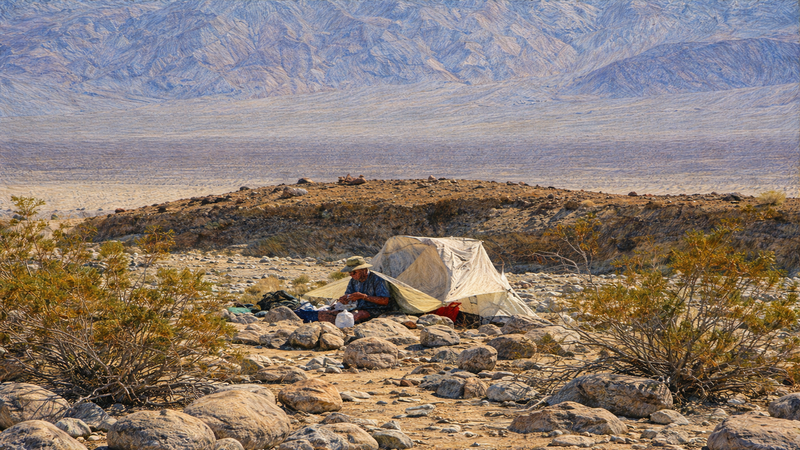
By mid-morning, I go to my camp and settle under a nearby tarp erected days ago. A high-pressure weather system has settled over the western United States, bringing uncommonly high temperatures for springtime in Death Valley. At our higher elevation, temperatures this week are expected to top out around 95◦. Staying too long in the direct sun will be dangerous—that’s why this place is called “Death Valley”—but under the shade of this well-constructed tarp, with a faint dry breeze moving through, this is lounging weather of the finest kind.
I lay still under the tarp for the longest time. Through shimmering air, I stare across the pale flats of the valley floor that glow like lit coals.
To fill these four days, I brought with me a writing project—an early draft of what you’re reading—a few novels, and Peter Ames Carlin’s latest book, Tonight in Jungleland. In the relaxing heat of the day, I decide to start with Carlin’s book about the making of Bruce Springsteen’s breakthrough album, Born to Run.
The record, with its cinematic storytelling and Wall of Sound production, has long been hailed as a masterpiece. Released in 1975, Born to Run catapulted Springsteen from near-total obscurity onto the covers of Time and Newsweek. His next few albums would send him hurtling into orbit as the global icon most people would come to know. According to Carlin, the album “captures the essence of fifties rock ‘n’ roll and the beatnik poetry of sixties folk-rock, projected onto the battered spirit of mid-seventies America.” It arrived during an unusually cynical time: right after the 1973 oil crisis, the Watergate scandal and President Nixon’s resignation, and the end of the Vietnam War. For working-class youth, Springsteen’s larger-than-life anthems offered hope that escape from this darkly apocalyptic time was possible.
Apocalypse? Hope? Escape? On first listening, 18-year-old Scott was all in.
Now, reading Carlin 50 years later, once again I’m all in.
Over the next four days, a pattern emerges. At first light, I wake up, have tea, and meditate for 40 minutes. In the cool morning hours, I write and edit The Alchemy of Story. Through the midday heat, I return to 1975, reveling in Carlin’s words. Just before sunset, I take a long walk, looking to integrate what I’m reading and remembering with what I’m writing.
At age 18, I was a mess.
I was a desperately lonely kid, a year removed from my parents’ home, who often wondered where in the world he would ever belong. I was a college sophomore in Berkeley, a.k.a. “Bezerkley,” experimenting with mind-altering drugs, twice with frightening results. I was a sexually naïve kid who wouldn’t come out of his gay closet for another four years.
I was a mess with three s’s.
Desperately in need of a mentor, an older brother, a guide, I latched onto the 25-year-old Springsteen, who in his music modeled how to grow up, how to stand tall, how to walk through the world. Whether in his musical storytelling blasting in my dorm room or his fiery presence in concert, he offered life lessons no college classroom would ever teach. How to be honest and self-revealing. How to transform youthful righteousness into integrity and generosity. How to live life with passion.
Along with the Carlin book, I brought to the desert an MP3 player full of Springsteen music, much of it live recordings from 1975 to 1985, his rock ‘n’ roll heyday. On day two of the solo, I listen to Born to Run straight through, and from there, I move on to select songs from the live recordings. These songs are so much more than great, high-energy music. Each one is a sonic placeholder for coming-of-age memories.
After the release of Born to Run, I saw Springsteen live three times in four years. The last show—Winterland Ballroom on December 15, 1978—was the best live performance I’ve ever seen. During my teens and twenties, I went to countless rock concerts: the Rolling Stones, Pink Floyd, the Who, David Bowie, the Grateful Dead, Bob Dylan, Van Morrison and more. While some played equally great music, none of them told intimate stories like Springsteen did, be that in his songs or in his banter with a crowd.
On day three of the solo, I cue up the KSAN-FM recording of that 1978 Winterland show. Over the course of the day, I listen to much of the show—full volume for my favorites, while fast-forwarding through tracks I never really liked. From the very first song, I’m transported back in time.
“Badlands, you gotta live it every day. Let the broken hearts stand as the price you’ve gotta pay . . .”
On this night, three years after the release of Born to Run, I’m 21 years-old. I’ve just graduated from college with a useless degree in physics. I’m still terribly lonely. I’m living in a queer closet. And, I don’t have a clue what I’m meant to do with my life—except show up for this concert.
Having arrived early, I’ve got a standing-room-only spot 20 feet from the stage. For the next three-plus hours, right before me is Bruce: standing and strutting, singing and storytelling. He’s electricity personified, sparks flying everywhere. I catch fire. By mid-show, I block out the throngs of people around me. It’s just Bruce and me, as he sings and tells his stories. About growing up. About his difficult father. About betrayal and redemption. About struggling to make his mark in the world.
He’s the best friend I’ve been aching to have for so long.
When Springsteen finally walks off stage, I again become part of the crowd of 5,000. Together, we all scream: “Bruuuuuuce, Bruuuuuuce, Bruuuuuuce . . .” He comes back for three encores and eight more songs, before finally releasing us into the night. I go home feeling vibrant and alive, seen and understood, uplifted and inspired.
Later that third day, I take another twilight walk down Lemoigne Canyon, just as the sun is dropping behind the jagged western ridge. The canyon walls, so pale and bleached at midday, have turned amber and deep rose. My boots crunch the same gravel I’ve been walking for days, but the sound is different now—quieter, more intimate—as if the desert itself is settling in for reflection.
It’s then that a larger pattern starts coming into view.
In The Soul’s Red Thread, I tell a true story about “a long, salty kiss” I once had with Dean, my first gay friend, while we were traipsing around San Francisco’s Union Square during Christmas time. Dean and I never became lovers, and yet that seismic kiss marked the very start of my coming out as a gay man. That threshold crossing—I realize during this twilight desert walk—came during the week after the Winterland show. Bruce’s passionate music, his intimate storytelling, and his endearing stage presence had ignited something in me. He had given me the courage, the confidence, the passion to take my honest place in the world.
As the sky starts to darken, I scan across all my memories of seeing Springsteen live. In October 1999, when I was almost 43, I saw Springsteen in concert for the first time in two decades. By then he had been playing in much bigger arenas and my seat was up in the rafters. Still, Bruce did not disappoint. I remember getting out of my chair right from the first song “My Love Will Not Let You Down,” and I remember after the show scouring every possible source for live recordings. At the time of that concert—I realize now, here in the dusk of the desert—I was preparing to do my first vision fast at Hanaupah Canyon over the New Year. That concert, and all the live Bruce music I listened to during the ensuing months, reawakened the passionate kid I once was, which helped to power me through a desert rite of passage that would dramatically change my life.
At the turning point of the twilight walk, I stop and stare across miles of open desert floor. The last light gilds the far ridgeline. Below it, the valley stretches out like something primordial and patient, indifferent to my small human life—and because of that, oddly freeing. I then see all that Springsteen has meant to me these past 50 years. When I was a teenager, during a midlife crisis, and right now. Each time, his music has given force and direction to a life about to change.
For that confused teenager, this meant channeling a great inner passion that would fuel an escape from the darkness of youth.
For the established doctor stuck in a midlife crisis, this meant doing a four-day fast to realign his outer life with a true self lying within.
For the wilderness guide I am now, this means channeling that passion, yet again, in support of these ten people who are here dying to an old life, so they might be reborn anew.
In the silence at dusk—a silence so complete I can hear my own heartbeat—I see a bigger truth that transcends my own personal story. In this desert ceremony, the Great Ballcourt Fast, personal passion is what every initiate must access if they’re to ignite their own fire, and the spaciousness of this desert provides the much-needed oxygen for that fire to burn.
Without that passionate spark, without all this open space, there is no fire of transformation.
☼ ☼ ☼ ☼
When I first began writing The Soul’s Red Thread, I read widely about the human capacity to remember. Memory, I came to see, lies at the very heart of our great urge to tell stories: experiences into memories into stories into identity.
Of all I read, most important was Daniel Schacter’s The Seven Sins of Memory. Schacter’s basic message: our ability to retain accurate memories is seriously flawed. If I revisit a long-ago experience, I’ll recall, at best, a few solid puzzle fragments of what happened. Arriving early for the Winterland show to get near the stage. The tunnel vision at the peak of the show. The exultant feeling by evening’s end. How I then put together a memory mosaic from those few pieces will be in service to my present-day identity more than what actually happened long ago.
Is this a problem?
No, says Michael Pollan in his latest book A World Appears: A Journey into Consciousness.
Memory helps constitute self, but at the same time, selves are constantly hacking their memories in order to better adapt to changing conditions. Never set in stone, memory is malleable clay that the self reworks as new circumstances demand. Forgetting helps us in this continual work of revision, as memories are compressed and shorn of context, allowing them to be freely reinterpreted in new and more useful ways.
Human memory isn’t faulty. It’s malleable. And what a boon that is!While we retain memory fragments from long ago, we lose much of the detail, which leaves us free to reshape our stories about the past in service to our present-day reality. But to do this reshaping well—to restore and re-story ourselves—we may need to step away from the great rush of our daily lives.
That’s what the ten people are doing at their solo spots. And that’s what I’ve been doing during these days in basecamp.
I’ve been calling upon Carlin’s words and Springsteen’s music to bring back long-ago memories of the 18-year-old I once was. That, in turn, has allowed me to bring forward the lessons and gifts from that time, so they might inform who I am, right now. A teenager’s embryonic reaching for honesty, authenticity, integrity. The hope that he might rise above. And, most of all, the passion to make all that happen.
These are the very qualities I most need as a wilderness guide.
☼ ☼ ☼ ☼
One by one, the ten initiates return safely to basecamp. Passing through the threshold circle, they leave the realm of spirit and return to our human community.
Cynthia and I will hold a series of story councils over the next three days, the first being late this afternoon after the worst of the heat has passed. Until then, she and I will keep the day intentionally open, each person free to slowly return to their bodies—tasting the miracle of food, relearning how to live in a social world, enjoying a sponge bath after days of not washing, or soaking up the desert heat in the shade of a tarp.
This also leaves me free for hours more.
Wanting to conserve energy for the story council to come, I pass the time lounging about: listening to an occasional song—still only Bruce—but mostly staring into the distance and reflecting. I think about this group of ten. I think about the Ballcourt ceremony. I think about all the years I’ve devoted to this desert work.
Soon, my mind floats back to my own first vision fast, 25 years ago, over in Hanaupah Canyon. I recall the most vivid memory from that four-day solo.
On the last evening, during an all-night vigil, I’m lying on my back, staring at the starry night sky for hours. No moon. No city glow. Just a Milky Way so dense and close it seems within reach. For the first time ever, I see how immense the cosmos is, and how infinitesimally small I am.
“Just a speck of cosmic dust,” I write in my journal. “A speck ready to be reborn. Ready to be cradled in the arms of the Great Mother.”
At sunrise comes rebirth. Rebirth into a new life, a new story, a new way.
In the shade of my tarp, I see so clearly: I’ve been on the Incorporation Road ever since.
Ten months after that, I was assisting at another wilderness fast. A year later, I did The School’s two-week guide training. The year after that, I began co-guiding day walks, the short form of a vision fast. The following year, I co-guided a four-day fast. Two years later, I left the AIDS Clinic, so I could devote myself to supporting people who were dying physically (as a hospice doc) and those who were dying symbolically (as a wilderness guide).
And that road has led me back to the desert again. Right here, right now.
In another few hours, the group will circle under the shade of a much larger tarp, and there each person will be invited to forge the first telling of their new life story. The first step on Incorporation Road.
What happened when you were out there, all alone?
What of the old life has died?
What visions of the new life were you given?
In the telling, each initiate will begin that uniquely human process: turning memories of a profound experience into a new story—a story that just might reshape their once-fixed identity and alter their life course. With the deep listening of this supportive circle, each person’s newly emerging identity will feel potent, alive, luminous.
Trouble is, old stories don’t always die easily.
Once a person goes back home, they’ll be surrounded by the same friends, the same family, the same job, the same responsibilities—all of which will mirror back their same old identity. The challenge becomes reconciling a new desert vision with this old life. “This ceremony won’t make your life easier,” we often say at The School, “but it will make it more authentic.”
The raven, our guardian at the gateway to the realm of spirit, has returned. She hovers in the sky above, staring at me, and then swoops down. She settles on a large rock just a stone’s throw away.
“Mirroring a person’s story is the most exhilarating work I know,” I say out loud to the raven. “How best to do that?”
She turns to look at me, staring intently. Be sure to mirror back their passion, I hear her say.
“Yeah,” I answer out loud. “I get it.”
As I think about this for a few heartbeats, a lizard flicks across the nearest rock and vanishes.
When I tell a story back to a faster during story council, the words I speak are important. But what matters most is that I fan the flames burning inside them.
“Yep. That’s what’ll light their way home.”
After the raven flies away, I’m left to mull that over for the longest time.
A half-hour before the council is set to start, I make myself a cup of extra-strong black tea and sip quietly. As the time to leave my own camp nears, I cue up my latest go-to Springsteen song: the Winterland version of “The Promised Land.” The original is on Darkness on the Edge of Town, an album that came out when I was 21.
Earpieces in place, I turn the volume to max:
“Blow away the dreams that tear you apart.
Blow away the dreams that break your heart.
Blow away the lies that leave you nothing but lost and brokenhearted.
The dogs on Main Street howl
‘Cause they understand
If I could take one moment into my hands.
Mister I ain’t a boy, no I’m a man
And I believe in a promised land.”
Burning bright within, I walk over to our tarp-covered circle and take my seat. Cynthia and I each say a few opening words about story council.
One of the fasters volunteers to go first. Over the next 20 minutes, she tells a riveting story about her four days and nights alone in a wide-open wash. What she’s left behind. How she journeyed in between. The vision of life she sees before her.
I sit stock still, listening deeply.
When it’s my turn, I mirror back more than her words. I mirror back the fire that will light her way home.
Leave A Comment